Union Budget 2026: Middle-Class Tax Relief May Continue as New Tax Regime Gains Ground
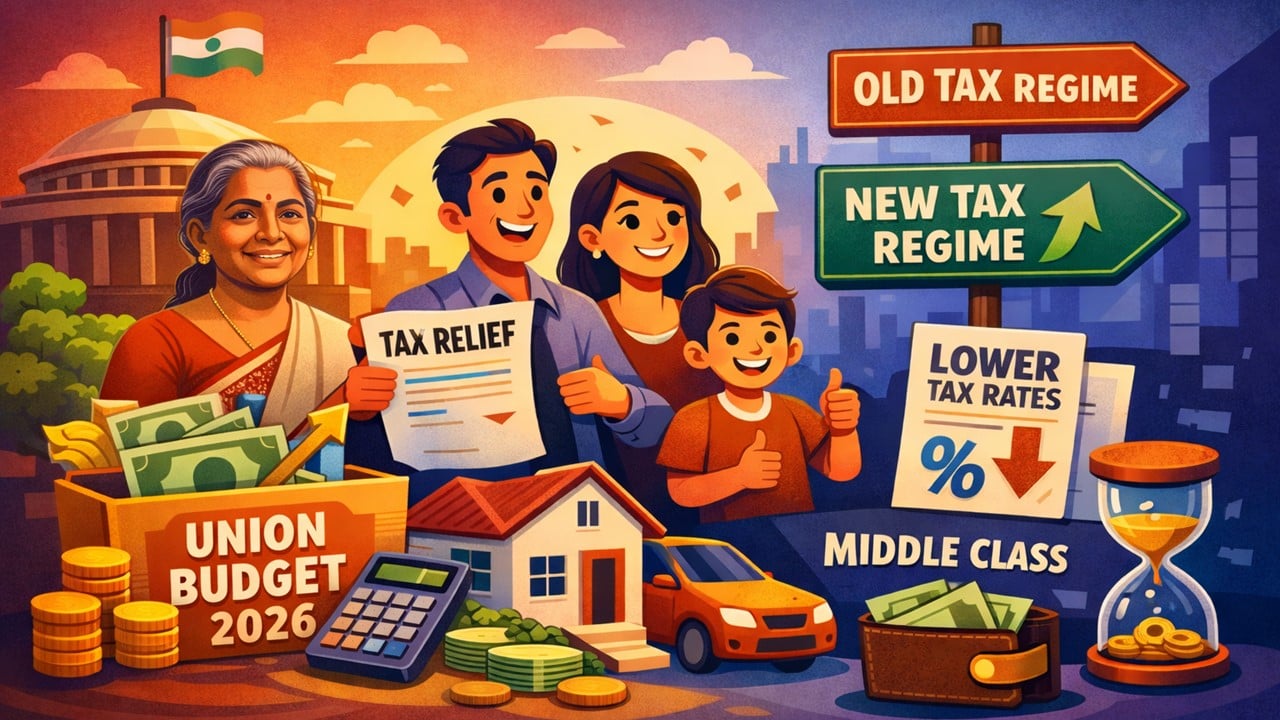
Union Budget 2026: Middle-Class Tax Relief May Continue as New Tax Regime Gains Ground
Finance Minister, Nirmala Sitharaman is likely to present the Union Budget 2026 on February 1, 2026, and expectations are already building around possible tax relief for the middle class. Much of this anticipation comes from the sharp increase in the basic exemption limit under the new tax regime announced in Budget 2025, which fundamentally altered how many taxpayers view their annual tax outgo.
Over the past year, the new tax regime has gained significant traction, with a growing number of individuals opting out of the old system. This shift has prompted many taxpayers to rework their financial planning and has also sent a clear signal to the government about changing preferences. Tax professionals believe this widespread adoption is likely to influence the direction of tax proposals in the upcoming budget.
Small Savings Schemes Remain Attractive as Government Retains Interest Rates for Jan–Mar 2026
How the New Tax Regime Provides Relief to the Middle Class
Under the new regime, income up to Rs. 12 lakh is effectively exempt from tax. When the standard deduction of Rs. 75,000 available to salaried employees and pensioners is factored in, the tax-free threshold rises to Rs. 12.75 lakh. For a large section of middle-income earners, this has translated into immediate and meaningful savings.
The impact becomes clearer with examples. Earlier, a person earning Rs. 7.5 lakh would have paid around Rs. 65,000 as income tax. Under the new regime, that liability reduces to zero. Even those earning up to Rs. 15 lakh see a reduction of nearly 25% in their tax burden, approximately Rs. 36,400, compared to what they would have paid under the old structure. Tax relief is even more pronounced for those earning between Rs. 20 lakh and Rs. 25 lakh, where savings can go up to about 30%. Beyond Rs. 30 lakh, however, the benefits gradually reduce. This design reflects a deliberate policy choice to concentrate relief on the middle-income segment rather than the very top end.
Economists point out that putting more money in the hands of the middle class can have a ripple effect across the economy. Higher disposable income typically leads to increased consumption, better savings, and greater investment, all of which support broader economic growth. Due to this, many experts expect the Union Budget 2026 to continue building on the middle-class-friendly direction set last year.